
Interval Training for Runners: Benefits and Techniques
by Published on: 20 October 2025

Interval training is one of the best ways to improve running strength, speed and endurance. Yes, it’s important if you’re trying to improve your running performance. But it’s also a valuable tool for improving overall conditioning and heart health.
In this article, we provide an overview of what interval training is, explain its importance, and suggest some exercises while running as well as some non-running interval training tips.
What is Interval Training?
Interval training in running is a workout method that alternates between periods of high-intensity (aerobic) running and lower-intensity (anaerobic) recovery (either jogging, walking, or complete rest). It’s designed to improve speed, endurance, and cardiovascular efficiency by pushing your body to run faster than your normal pace for short bursts, then recover before repeating.
The idea is to run (or do another serious cardio activity) for at least 75% of max effort for a certain amount of distance or time, and then recover, at a slower than average running or walking pace. The cycle is repeated for a certain number of times, or reps. You get the benefits of being able to increase intensity, but also reducing the time it takes for the heart rate to recover.
Why Is It Important
There are three main benefits of interval training:
- Increasing speed. Helps you run faster for longer.
- Increasing endurance. Both pace and distance.
- Improving cardiovascular strength. Exercise for longer at a higher heart rate, but also improves recovery time of heart rate.

Interval training has major benefits for running, but there are similar benefits for other serious cardio activities, such as cycling and swimming. In running, you might be familiar with the term fartlek, which is an interval training technique.
Interval Training Running Exercises
There are all sorts of sites that will provide suggestions for sample interval workouts. The basic idea is to increase intensity, and then recover. Some popular running interval routines include:
The basic idea is fartleks or Run Repeats. Run faster than your average pace, and then recover by running (or walking) slower than your average pace. Beginner, intermediate, and advanced workouts are based on time, distance, and the ratio of intensity to recovery. Some examples:
- Beginner. Run fast for 1 minute, then recover for two minutes. Try it 5-6 times, and then increase the number of times you do it for (‘reps).
- Intermediate. Increase the time or distance, and reduce the recovery ratio, say 1:1.
- Advanced. Longer times and distances, and a ratio of 2x intensity to 1x recovery.
Over time, increase the time/distance, number of reps, and adjust the intensity to recovery ratios. But there should always be a recovery!
Note this doesn’t have to be scientific!! While it might be helpful to have a watch or running watch to track time or distance, neither is necessary. One way we love doing interval training when running is to just pick a landmark, such as a telephone pole or hydrant, and alternate faster/slower. Up the training by just going for longer distances between landmarks, doing an interval type run for longer, and/or increasing the number of reps.
Another key to interval training is to not do it too often. It should be part of your training, perhaps 1-2 times per week, but not more than that.
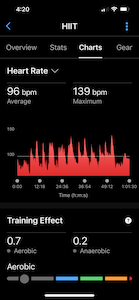
If you have a heart rate monitor or fitness watch that tracks heart rate, you can see the difference between a regular run and an interval run. A regular run will show a steadier average heart beat, while the interval activity will show peaks and valleys.
Interval Training on a Treadmill
Interval training can be done while running outside, there are also effective ways to do it on a treadmill. Manually, increase apply the same principles to pace and time. Another feature of treadmills is the ability to adjust elevation, which is another way to increase intensity (and train for hills).
Most treadmills also have a variety of interval type programs that can be chosen from. The same applies to other cardio machines, such as the elliptical, stair climber, or indoor rower.
Non-Running Interval Training
You don’t have to run to do interval training! Apply the interval training technique or intensity/recovery to other cardio activities, such as cycling, swimming, or rowing – whether inside or outside.
Also, look for classes that specify intervals, such as High Intensity Interval Training (HIIT). Most gyms have HIIT type classes. There are some companies that specialize in HIIT, such as F45. It can be fan, motivating, and less boring Peloton has HIIT
You might also hear of the term Tabata applied to interval training. Tabata is a specific technique of shorter bursts and active recovery. The strict definition of Tabata is a 2:1 ratio, for example 40 seconds ‘on’ and 20 seconds ‘off’.
Overall, there’s a wide variety of interval programs, techniques, and instruments (i.e. machines), but the basic principle across all is the same!